
What Is SEO?
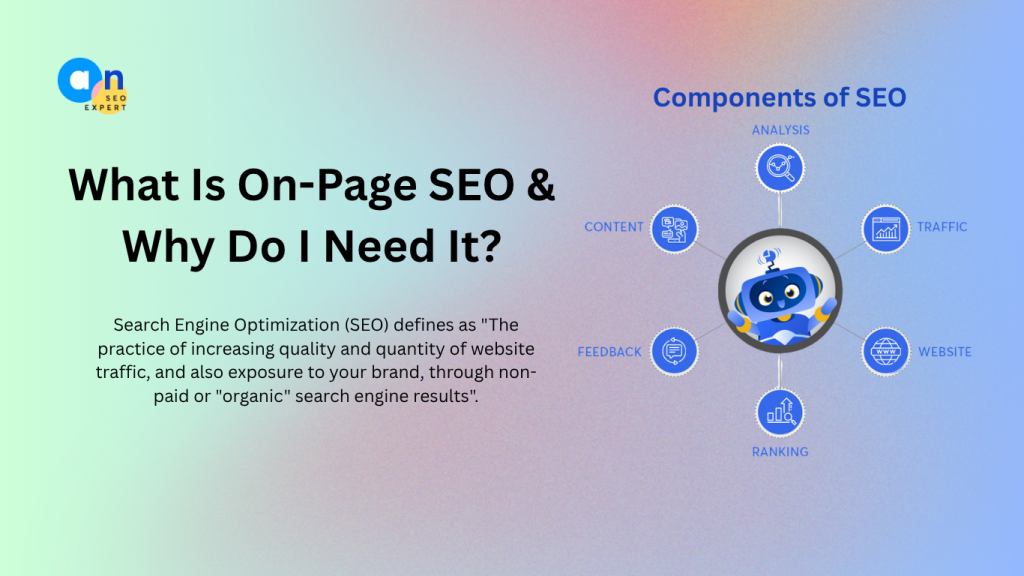
Search Engine Optimization (SEO) defines as “The practice of increasing quality and quantity of website traffic, and also exposure to your brand, through non-paid or “organic” search engine results”.

From SEO definition, we can understand that while performing SEO strategies our focus should be Audience and Crawler.
Search Engines
You might be thinking that what is Search Engine?. Here you can understand the basic concept of Search Engines.

Search Engine is basically the answering machine that evaluates thousands of factors to determine the best possible answers. They do all of this through a process known as crawling and indexing. After crawling and indexing search engines rank certain content according to different algorithms.
As in the definition of SEO we see the term Organic results or non-paid results. Now let see what does this term mean?.
Organic Results
Organic results basically earned through effective SEO, means not from advertising (not Paid). Organic search determined by Search engines based on unpaid, natural rankings determined by search engine algorithms.
We can optimize organic searches through various effective SEO practices. There are different factors through which we can get organic search results like:
- Identify Target Keywords
- Perfect On-page optimization
- Develop Content Strategies
- Monitoring and keep optimizing SEO efforts.
Types Of SEO
There are basically 3 types of SEO and they are important for your overall Marketing Strategy. We will not discuss all types in this post except On-Page SEO.
- On-Page SEO
- Technical SEO
- Off-page SEO
On-Page SEO:-
On-Page optimization includes such strategies through which you can optimize a page on the website. This type of SEO covers:
- Keyword Research
- Content Creation
- Keyword Optimization.
Technical SEO:-
Technical SEO is related to non-content elements like:
- Site speed
- Mobile-friendliness
- Indexing
- Crawlability
- Site architecture
- Structured data
- Security
Off-Page SEO:-
Off-page SEO or off-site SEO strengthen the relation of your websites with other websites. Through off-page SEO, you can build a website’s reputation or authority.
SEO Tactics
Here the list of best SEO tactics is provided:
- White Hat SEO: 100% follow Google’s Webmaster Guidelines.
- Grey Hat SEO: Try to develop the content specifically to get links.
- Black Hat SEO: Buy links and look for ways to get the algorithms to boost site, outside of Google’s guidelines.
What Is On-Page SEO?
We will discuss web-page optimization but before that, we need to understand what on-page SEO is all about.
Remember on-Page SEO is basically the foundation of your campaign.

To succeed in the search engine you need to implement On-page in a great way. On-page SEO is the practice of optimizing webpages to rank them higher in the search engines.
You can also define like, it is the process to optimize Website, Content, and Code.
If you do proper On-Page SEO it will help you to rank higher in the Search Engine
On-Site SEO can be broken down into two parts and those parts are:
- User Experience
- Code Optimization.
User Experience
Let’s discuss what does user experience mean according to the SEO perspective. In the old days, SEO was quite simple and people stuffed a page full of keywords and get ranked number one. Now this will not work as Google considers User Experience as SEO best practice.
Code Optimization
In code optimization, we need to make sure that crawler could easily crawl our HTML code and other elements of the site.
User experience and Code Optimization will let crawler and users to decide the worth of your content. As we discussed the optimization so you might be thinking What does Optimization process involve?.
Do You Want To Optimize Web Pages?
If you have a keyword and great content then you can rank webpages as it is not much difficult. You need to understand how to optimize the webpages to make Google realize that it deserves a place on the first page.
What Does Optimization Process Involve?
Unfortunately, the majority of On-Page SEO advice focus on the exact placement of the keyword. They focus on the exact match on your page, Title, Meta Description, H1 heading, Subheadings, and etc.
According to the latest update, Google can understand the synonym and semantically related Keywords. As Google is now smart enough so you don’t need to use exact match keywords on your web pages.
Take a look at the top results of the “best apple computer“.

In the above image, out of Ten results, you can not find a single result in which exact keyword is used. These results cover the following points:
- Best MacBooks
- Mac buying guide
- Which Mac should you buy?.
If you want to optimize your webpages according to latest Techniques then follow these 8 On-page SEO tips.
On-Page SEO Tips
Here is the list of some helpful on-page SEO tips.
- Fast Page Loading Speed
- Make Content According To Searchers
- Strategic Placement of Keyword in Title, Meta Description, and H1 tags
- Use Short URLs
- Use Alt Tags for Images
- Increase CTR by using Schema Markup
- Increase “Topical Relevance” Make things Easy For Google
- Simple and Readable Content
Fast Page Loading Speed
If you are curious to know that Page loading speed matters or not? then obviously it matters. While searching on search engine every single person does the same thing as me. Whenever the page takes time to load I click the back button and search for another result.
Slow loading speed is annoying, so page speed is also a ranking factor. You can use the Google Page Speed Insights Tool to improve your page speed.
You can also follow these two tips to improve your Page Speed:
- Reduce Image Sizes
- Minimize Useless HTML.
Make Content According To Searchers
Let’s take an example of a Cricket coach picking players for a team. A coach will select only those players who meet their requirements.
Similarly, in SEO think Google as a Coach and Web pages as players. Google will rank or pick only those pages that meet Google requirements.
Google requirement is to provide what searchers are looking for. Here question is to understand how we can figure out what searchers want?.
This is not much difficult like here is an example for you. If your keyword is “buy protein powder”.

These SERP overviews showing that this is what searchers want to see.
Strategic Placement of Keyword:
I know at the start of the article I said this exact keyword placement factor doesn’t matter. My point was, this factor is not as much important as it used to be.
This factor will work for you if you put your targetted keywords where it makes some sense. You don’t need to do keyword stuffing.
There are some specific reasons due to which we recommend using strategic placement of keywords. Here are some reasons:
- Correlation between rankings and the strategic placement
- It demonstrates searchers that specific result is relevant to a user search query
Use Short URLs
Make sure that you use a short descriptive URL for your web page. Here is an example for both short and long URL and you can understand the reason to use short URLs.
Long URL:
https://www.medicalnewstoday.com/articles/323425.php.
Short URL:
https://www.doctordiet.com/how-to-gain-weight.
Now there is a question for you, Can you tell me what that page is about having a long URL?. I am sure it’s not possible for you.
Now have a look at short URL and everyone can tell that it is about to gain weight. These short descriptive URLs are also good practice for on-page SEO.
In short URL we can target our main keyword which is effective to rank our page.
Use Alt Tags for Images
You should use Alt tags for images and describe your images as accurate as possible. Using alt tags is also effective for your on-page SEO.
Increase CTR by using Schema Markup
Through Schema Markup Search engines can make a better understanding of your web page. Here is an example with and without Schema markup.

Increase “Topical Relevance” Make things Easy For Google
Remember use topical relevance as Google can better identify the topical relevancy of content. Google identifies through the co‐occurrence of words and phrases.
For example, if you have a page with the title “Omelet Recipe!”. Now making easy for Google is to write content related to Omelet recipe. As it’s unlikely that such a page have anything but an omelet recipe.
Simple and Readable Content
Imagine someone writes an article for you in Shakespearean language that is difficult to understand. Always write your article according to your audience level and try to write in a simple way.
You can follow these few tips for keeping your content simple:
- Avoid “big” words
- Use short sentences and paragraphs
- Keep things informal
On-Page SEO Checklist
Here is a list of on-page SEO checklist:
- Title Tags
- Meta Descriptions
- Content
- Heading Tags
- Canonicalization of Duplicate Content
- URL Structure
- Crawl Error Resolution
- Check Robot.Txt Filed
- Page Speed
- Multi-Device Friendly
Importance Of On-Page SEO
On-page SEO tells search engines who you are. It tells why you should be at the top of the search results when your keywords entered.

With the help of on-page SEO, you can get your target visitors. It is really important to feed Google Crawler as much information as possible.
You should focus on On-page SEO but this does not mean you can ignore your user. You are required to optimize your content for search engines. Similarly, try to make this content as much helpful for the user as you can.
How To Check On-Page SEO?
You can also check On-page SEO by following these simple and important steps.
- SEO audit: First of all launch SEO audit for the whole website.
- Website Rank Checker: You also have to check website positions by keywords.
- Backlink Checker Tool: Check your backlinks to gain more traffic.
- On-Page SEO Checker: Submit your website URL to check SEO Parameters.
- Website Traffic Checker: Estimate your websites traffic stats by channels
On-Page SEO Video Tutorial
Here video is also provided so watch and implement concepts on your websites.
20 Best SEO Tools

If you are looking for the best SEO tools then here is the list of latest best SEO Tools is mention.
- Google Keyword Planner, Analytics, Search Console, etc
- Ahref
- Yoast SEO
- Hunter.io
- Link Miner
- Responsive Design Checker
- SERProbot
- Keywords Everywhere
- Similarweb
- Smush Image Compression and Optimisation
- GTMetrix
- Wondersear.ch
- Whitespark’s Google Business Review Link Generator
- Portents SERP Preview Tool
- Robots.txt Generator
- HeadmasterSEO
- Merge Words
- Beam Us Up
- Answer the Public
- Keyworddit
Google Keyword Planner, Analytics, Search Console, etc:

Google free tools include:
- Keyword Planner (Find and Research Keywords)
- Trends (Identify trends)
- Search Console (Fix Technical and On-Page Issues)
- Analytics Tool(It is used to Analyze how many people are visiting your website)
- Pagespeed Insights (Check how fast your site loads).
Ahref Backlink Checker:

Ahrefs’ Backlink Checker help to shows the top 100 backlinks to any website.
Yoast SEO:

You can use the Yoast SEO tool to optimize meta tags and content, generate instant sitemaps, and much more.
Hunter.io:

This tool finds all email addresses related to a website in seconds.
Link Miner:

Through this chrome extension, you can check any web page for broken links on the fly.
Responsive Design Checker:

This tool checks the responsiveness of your website. Submit your URL and see how it looks on desktop, tablet, and mobile.
SERProbot:

This Google tool allows you to check rankings for up to five keywords at a time.
Keywords Everywhere:

Keywords Everywhere display search volume, CPC, and competition data for Google in all the major search engines.
Similarweb:

Similarweb is a tool through which you can estimates the total amount of monthly traffic comes to your website.
Smush Image Compression and Optimisation:

This free plugin is used for compressing, optimizing, and resizing images on your site.
GTMetrix:

This tool is used to analyze the loading speed of your web pages.
Wondersear.ch:

It finds keywords that are semantically related to any root keyword.
Whitespark’s Google Business Review Link Generator:

This tool generates a shareable link that allows customers to review business with one click.
Portents SERP Preview Tool:

It will show you a preview of how it will look in the SERPs.
Robots.txt Generator:

This Robot.txt generator tool helps to generate a properly formatted robots.txt file in seconds.
HeadmasterSEO:

HeadmasterSEO is a tool for bulk checking the status codes for a list of URLs.
Merge Words:

With the help of Merge, Words you can merge up to three sets of keywords.
Beam Us Up:

Beam Us Up is a free SEO crawler. It’s a great alternative to Screaming Frog.
Answer the Public:

This tool fetches Google autocomplete queries in bulk and divides them into various lists.
Keyworddit:

Keyworddit tool simply extracts keywords from Reddit.
Conclusion
I hope now you can apply On-page SEO on your websites as I also mentioned a list of some important tools. SEO could not be cover in a single article still, I tried to cover all important points related to on-page SEO.
Now we recommend you to explore further about SEO. There are still many factors that you should cover to rank your website on Search Engine.
You also need to be updated about the latest news from SEO and Google industries. You can also visit Search Engine Land to get the latest Google Algorithms updates.